Free book · 162 pages
The non-U.S. founder's complete guide to the U.S. financial system
Learn how to open a U.S. bank account from abroad, take card payments without the account freezing, and have lenders treat your company like any American one. Everything a U.S. founder is handed by default, built from wherever you live.
- Form the company
- Get banked
- Take payments
- Build credit toward $50,000+ in funding
Where should we send it?
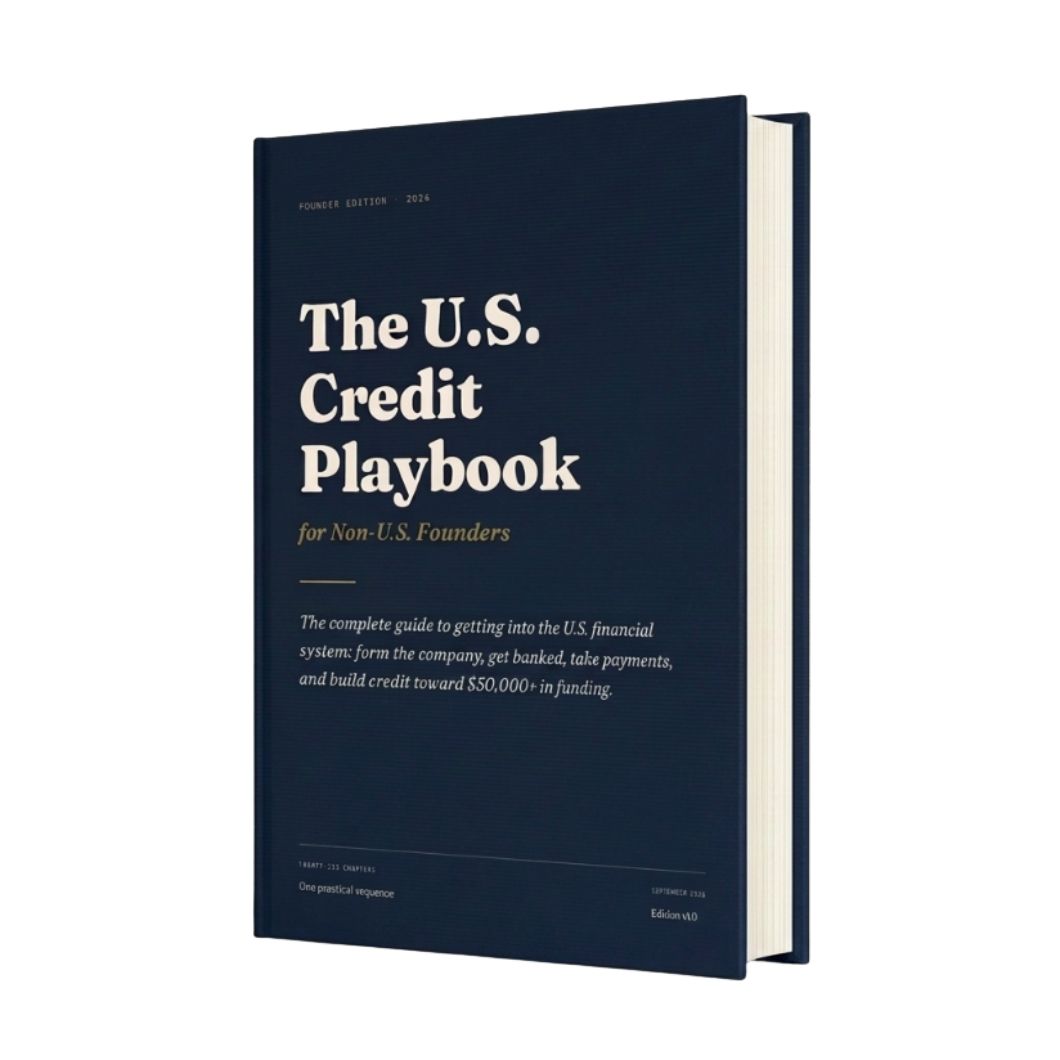
The book
Written in the order the work happens
Most advice on this arrives as scattered tips. This runs as one sequence, because the order matters more than any single step. Pick an address before you understand what it does and you won't fix one application later, you'll fix all of them.
What's inside
- Which state to form in, and what that choice doesn't decide
- Getting the EIN without waiting on international post
- Why a mailing address and a residence aren't the same claim
- What a bank sees when it looks at your address
- Payfacs, merchant accounts, and which one you need
- Cards that approve without a Social Security number
- The reporting date that decides what your file shows
- Building the company's credit file, separate from yours
- Six filings, and the one with a five-figure penalty
- Tax residency, and where zero percent really comes from
From the book
A residential address is a claim about where you live. A mailing address is a claim about where your post arrives. A friend may genuinely agree to receive your mail, and a forwarding service may deliver your statements reliably for years, but neither arrangement establishes residence. A form that asks where you live isn't asking where your letters land.
Chapter 7 — Addresses, and why the wrong one follows you around
All twenty-six chapters
01What the U.S. system makes possible
02What a company actually gives you
03Choosing a state, and what that choice decides
04How a lender reads your file
05The three-phase roadmap
06Identity, tax numbers, and verification
07Addresses, and why the wrong one follows you
08Getting banked, and getting paid
09Payment processing and underwriting
10Marketplaces and the second round of checks
11Advertising accounts and their verification
12Remote and in-person banking
13Choose the first account carefully
14Rewards without expensive spending
15Statements, payments, available credit
16Secured loans and the cost of a file
17Higher limits, transfers, reconsideration
18When you're declined
19Building the company's credit file
20Business borrowing beyond the score
21Working with a banker
22Cash financing and manufactured spending
23Errors, identity theft, and recovery
24Bookkeeping, filings, and the paperwork
25Research, records, and templates
26Tax residency, and the zero percent question
Who it's for, and who it isn't
Read this if
- You're not a U.S. citizen or resident
- You're running a real business, or about to
- You've been declined and nobody explained why
- You want this done properly, not quickly
Skip it if
- You want a shortcut around the checks
- You're looking for guaranteed approval
- You want funding this month
- You already have a U.S. credit file
Questions
Is it actually free?
Yes. The whole book, all 162 pages. You give an email address, we send a PDF. We also sell services, and some people who read it end up wanting help. Most don't, and that's fine.
Do I need a Social Security number?
No. That's the point of the book. It covers the routes that exist for people who can't get one, including which card issuers accept an ITIN and which don't check for an SSN at all.
Do I need to visit the United States?
Not for most of it. There's a chapter on in-person banking for people who can travel, because it opens some doors, but the book is written for people doing this remotely.
Will this work from my country?
The system doesn't care much where you live, but individual banks and processors do, and their rules change. The book tells you how to find out before you apply rather than after you're declined.
Does this guarantee I'll get approved?
No, and be careful with anyone who says otherwise. Forming a company, holding a tax number, or having an address doesn't entitle you to approval. Banks decide on their own criteria. What the book gives you is the right order to work in, and a way to know which specific thing is missing when you're turned down.
How long does this take?
Depends where you're starting. Chapter 5 lays out what a realistic first year looks like, with decision points rather than a fixed schedule.
How often will you email me?
Roughly weekly, and less if we've nothing worth saying. Unsubscribe link in every email, and it works immediately.
Get the book
All 162 pages, free. One email address, no card, nothing to cancel. If it isn't useful, one click and you'll never hear from us again.
Send me the book